






How Do You Choose the Right Coffee Color Sorter?
Release time: 2026-10-23
Table of Contents
Choosing a coffee color sorter machine involves more than comparing prices or advertised throughput. The equipment must identify the defects that matter, meet finished-product requirements, and fit into the existing processing line.
For green coffee exporters, roasting plants, and industrial processors, material characteristics, sorting targets, production demand, and verified performance should guide the purchasing decision.
1. Identify the Coffee Beans You Need to Sort
Start by determining whether the machine will process green coffee beans, roasted beans, or both. Different processing stages produce different visual characteristics, so the appropriate machine configuration and sorting criteria may vary.
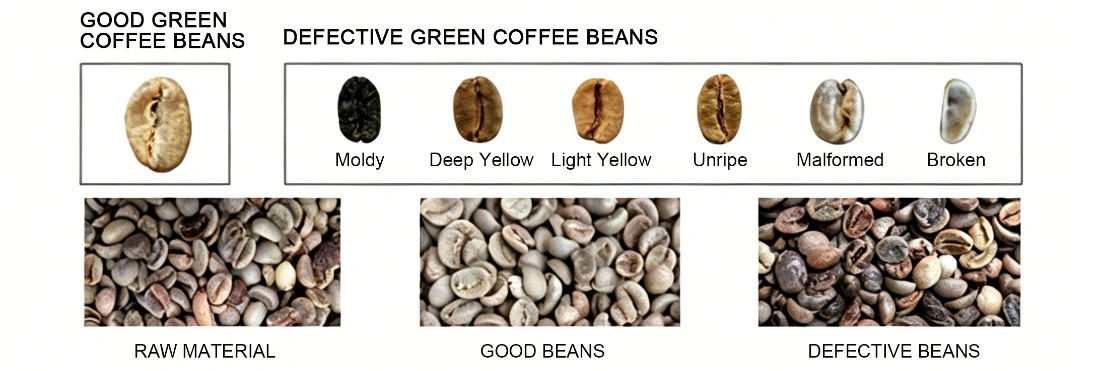
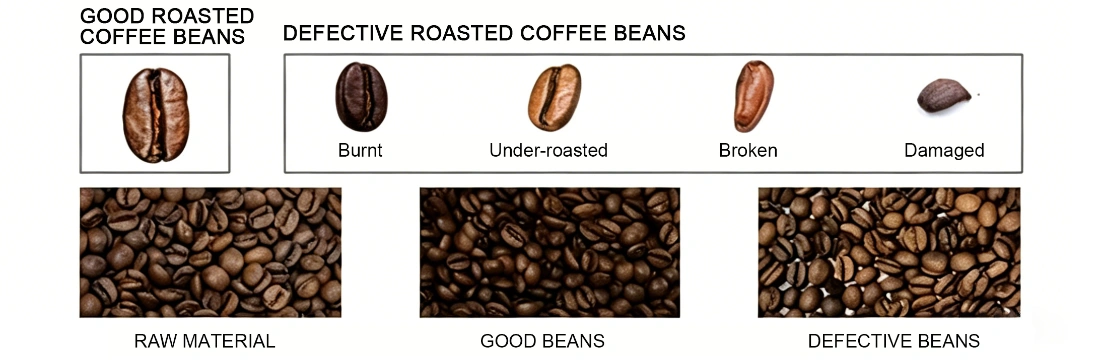
Green coffee processing may involve removing discolored, immature, broken, or otherwise undesirable beans. Roasted coffee sorting presents a different challenge, as differences in roasting can create variations in surface color and appearance.
Before selecting equipment, clarify:
- Whether the material is green coffee, roasted coffee, or a combination of batches.
- Which defects must be removed and which appearance variations are acceptable.
- What quality standards the finished product must meet.
- Whether the line processes one product continuously or switches between different sorting requirements.
These details help determine whether the proposed equipment fits the actual application rather than simply matching a product name.
2. Define the Defects the Machine Must Remove
A coffee color sorter separates material according to detectable differences, but not every defect is equally easy to identify. A machine should not be assumed to detect every quality issue simply because it uses advanced optical technology.
Potential sorting targets include visibly discolored beans, unusually dark or potentially over-roasted beans, broken beans, and certain foreign materials with sufficiently different appearances. Actual recognition performance depends on the sensing configuration, sorting algorithms, calibration, and the characteristics of the incoming coffee.
Hidden defects require particular care. Internal mold, concealed insect damage, and other defects that cannot be reliably identified from the exterior should not be treated as guaranteed detection targets for a conventional color-based system. Specific capabilities need to be validated through testing or complementary inspection methods.
When evaluating a Coffee Color Sorter Machine, ask the supplier to test representative samples and show both accepted beans and rejected material. The goal is not only to remove unwanted beans but also to avoid excessive rejection of acceptable coffee.
3. Match Throughput to Your Production Requirements
Throughput is an important purchasing criterion, but the highest advertised capacity is not necessarily the most useful figure for your operation.
Actual output may vary with bean size, feed consistency, defect ratio, material condition, and sorting criteria. A batch containing many defective beans may behave differently from a relatively clean sample, especially when strict finished-product requirements apply.
Consider the following factors when estimating the required capacity:
- Hourly output: How much coffee must the line process during normal production?
- Operating schedule: How much time is available after accounting for cleaning, setup, and product changes?
- Incoming material quality: How much preliminary cleaning or defect removal is needed?
- Finished-product standards: Will stricter sorting criteria affect good-bean recovery or throughput?
- Line integration: Can conveying, storage, and packaging equipment handle the expected output?
Ask suppliers to explain the material and test conditions behind their capacity figures. Performance data is more useful when it reflects conditions similar to those in your plant.
4. Evaluate Optical Recognition and Ejection Performance
Sorting performance depends on more than the ability to recognize a defect. The machine must also reject the identified bean at the correct moment without unnecessarily discarding good product.
When comparing a Coffee Bean Sorting Machine, evaluate three areas.
Optical recognition: Can the system distinguish the appearance differences found in your actual coffee samples?
Sorting algorithms: What recognition methods are included in the proposed configuration, and how are they suited to the target defects? If AI-based sorting is offered, ask for evidence of its performance on your material rather than relying on the technology label alone.
Ejection performance: Does the machine remove the targeted beans while maintaining an acceptable level of good-bean recovery?
A meaningful comparison should consider both the purity of the accepted product and the amount of usable coffee lost during sorting.
5. Check Installation, Operation, and Maintenance
A coffee sorter must work as part of a complete processing line. Before ordering, confirm the installation space, feed and discharge arrangements, electrical requirements, applicable compressed-air needs, and connections to upstream and downstream equipment.
Operational flexibility also matters. If the plant handles different batches or roast profiles, ask how sorting parameters are adjusted, saved, and checked after a product changeover.
Maintenance should be reviewed before the purchase as well. Discuss cleaning procedures, access to optical components, replacement parts, service arrangements, and technical support. Equipment that performs well during a demonstration but is difficult to maintain may create unnecessary production interruptions.
6. Compare Suppliers Through Sample Testing
Specifications help narrow down the options, but representative sample testing provides stronger evidence of suitability.
Before testing, agree on the target defects, finished-product standards, sample quantity, and evaluation method. Whenever possible, use material representative of normal production.
| Evaluation Criteria | What to Verify |
|---|---|
| Defect removal | Are the target defects effectively separated? |
| Good-bean recovery | Is too much acceptable coffee being rejected? |
| Product quality | Does the accepted sample meet the agreed criteria? |
| Throughput | What output is achieved under the test conditions? |
| Repeatability | Are results consistent across runs or batches? |
| Operating requirements | What cleaning, utilities, and operator input are needed? |
Ask the supplier to document the test conditions and retain samples of the incoming material, accepted product, and rejected material. If the machine is intended for both green and roasted coffee, test the two materials separately.
This process helps buyers compare suppliers using consistent criteria rather than relying on different definitions of capacity or sorting accuracy.
7. Compare Total Cost, Not Just Purchase Price
The initial purchase price is only one part of the investment. Installation, line integration, energy and compressed-air requirements, operator training, maintenance, spare parts, and downtime can all affect the long-term cost of ownership.
A more expensive machine does not automatically offer a better return, just as a lower-priced model is not necessarily the most economical choice. The key is whether the equipment can meet the plant’s quality and production targets under real operating conditions.
Consider these cost factors:
- Equipment purchase and installation.
- Routine maintenance and consumables.
- Operator training and after-sales support.
- The impact of defect removal on finished-product quality.
- Raw-material losses caused by rejecting acceptable beans.
- The effect of sorting results on downstream processing and customer acceptance.
Use your own production volumes, material conditions, and sample-test results to estimate the potential financial impact. Avoid calculating return on investment from advertised throughput or accuracy alone.
8. See APEX Coffee Color Sorter Demo Video
This demo shows APEX M32 compact color sorter sorting raw green coffee beans, removing twigs, insect-damaged beans, husks and stones.
APEX coffee sorting systems work for both Arabica and Robusta, covering green coffee beans as well as roasted coffee beans.
The compact M32 is ideal for small roasters, micro coffee processors and workshop-scale production with low to medium throughput. For large coffee exporters and bulk continuous processing lines, our A+AI high-capacity coffee color sorter delivers much higher hourly output to meet mass production demands.
Send APEX your coffee samples for a free custom sorting trial to verify the performance for your coffee beans.
Conclusion: Choose Based on Verified Performance
Choosing the right coffee color sorter requires a clear understanding of the incoming material, target defects, required throughput, product standards, and maintenance needs. Optical technology and recognition algorithms matter, but good-bean recovery, line compatibility, and verified test results are equally important.
For processors comparing suppliers, the most reliable approach is to define sorting requirements first and then validate equipment performance using representative samples. This reduces the risk of purchasing a machine that looks suitable on paper but does not match the actual production line.
APEX SORTING offers coffee color sorters and custom sorting trials for green and roasted coffee processing. For machine recommendations or sample testing, feel free to contact us.
Frequently Asked Questions
What should I consider first when choosing a coffee color sorter?
Start with the type of coffee, the defects that need to be removed, and the required hourly throughput. These factors help determine the appropriate configuration and sample-testing criteria.
Can one coffee color sorter process both green and roasted beans?
This depends on the specific model and configuration. Confirm the application with the supplier and test green and roasted beans separately if both are required.
How can I verify a coffee sorter’s actual performance?
Provide representative samples and agree on defect categories, finished-product standards, and test conditions. Evaluate defect removal, good-bean recovery, throughput, and consistency across runs.
Is an AI coffee color sorter always better than a conventional model?
Not necessarily. Results depend on the sensing system, algorithms, machine configuration, and target defects. Compare sample-test results rather than relying on the AI label alone.
What information should I provide when requesting a quotation?
Share the coffee type, target defects, expected throughput, finished-product standards, representative samples, and details of the existing processing line. This information helps the supplier assess the most suitable configuration.
Explore APEX Coffee Sorting Solutions
Visit the Coffee Color Sorter Machine category to review relevant equipment, or contact APEX to discuss your material, sorting targets, production requirements, and potential sample testing.